 NoNoise
NoNoise
NoNoise
Plan and optimize every hour of your day with visual time blocking. See your entire 24-hour schedule at a glance and master energy management.
Most people plan their day with to-do lists. They write down tasks and hope to get them done "sometime today." The problem: time is finite. You have exactly 24 hours, and most of it is already spoken for.
The insight: You don't need better task management—you need better time awareness. When you see your full 24 hours laid out visually, you understand where your time actually goes and can design a day that works.
Let's do the math on an average day:
That's 19-25 hours already allocated. Your actual discretionary time is tiny—maybe 2-5 hours on a good day. Understanding this changes everything.
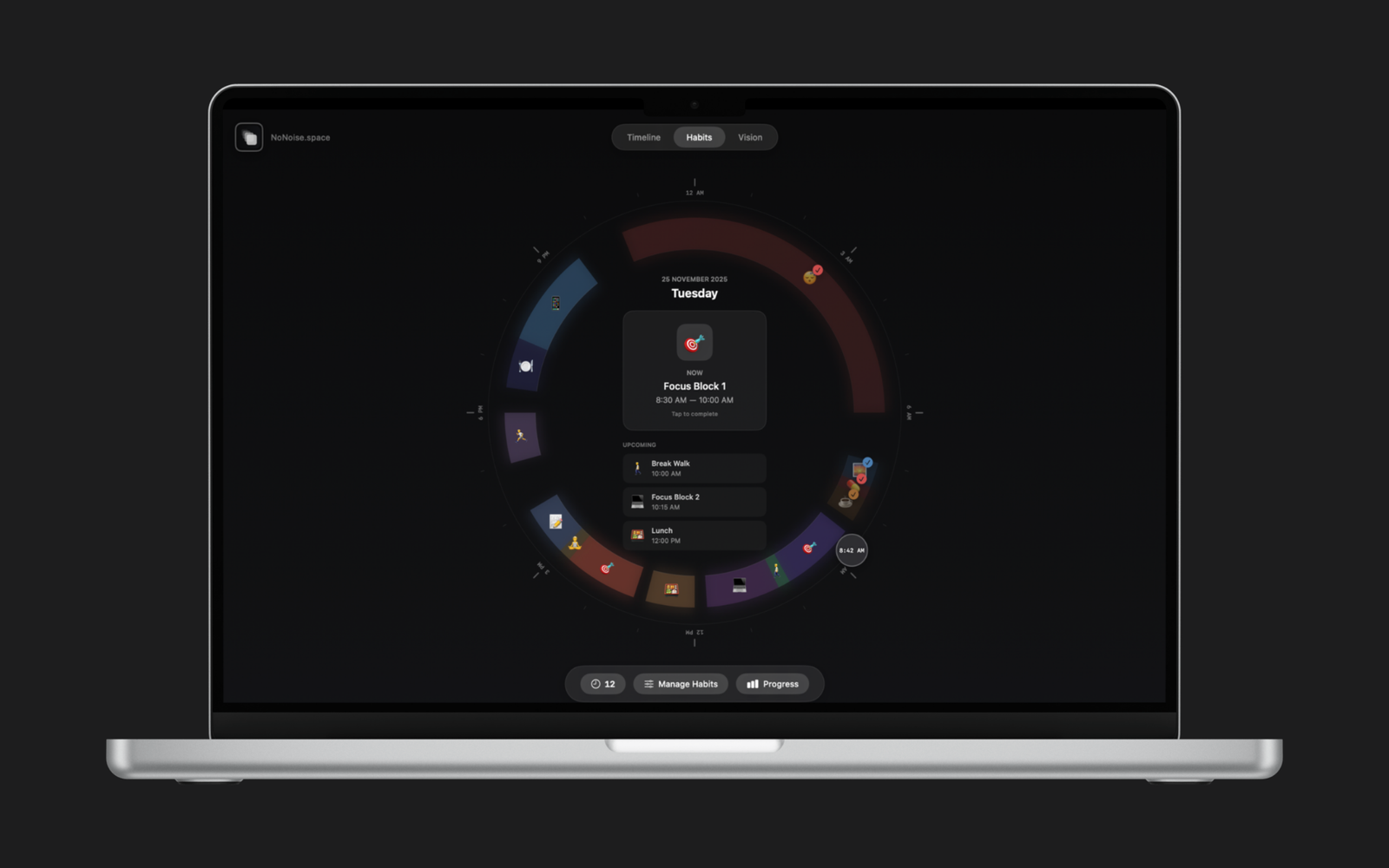
When you see your entire day as a circle (NoNoise's 24-hour clock), several things become immediately clear:
You can't commit to a 2-hour workout, 1-hour dinner prep, and quality time with family all between 6-8 PM. The visual makes the impossibility clear before you over-commit.
You start noticing you always crash at 3 PM, are most creative at 10 AM, or get a second wind at 8 PM. You can then schedule tasks accordingly.
The space between activities matters. You build in buffer time, transition rituals, and mental reset periods instead of racing from task to task.
When you see your sleep block as part of the circle, you understand it's not "wasted time"—it's the foundation for everything else.
"Work expands to fill the time available for its completion." When you don't time-block, tasks take however long they take. When you allocate specific time, you create natural boundaries that force efficiency.
Your brain doesn't maintain focus consistently throughout the day. It operates in 90-minute cycles called ultradian rhythms:
After 90 minutes, your brain needs a break. Fighting through this causes diminishing returns. A 15-20 minute break resets the cycle.
Notice: Only 5 cycles of focused work. That's all most people can sustain with high quality. More than that leads to burnout and diminishing returns.
1. Schedule Deep Work During Peak Hours
For most people: 9-11 AM and 4-6 PM. Avoid scheduling meetings or admin during these windows.
2. Match Task Type to Energy Level
High energy → Creative, strategic, difficult work
Medium energy → Routine, collaborative, communicative tasks
Low energy → Admin, organization, planning tomorrow
3. Build In Physical Movement
Sitting still for 8 hours straight destroys energy. Include: morning exercise, walking meetings, stretching breaks, standing work periods.
4. Protect Your Sleep Block
The 24-hour view should include sleep as a non-negotiable block. Everything else works around it, not instead of it.
Between 2-4 PM, almost everyone experiences an energy dip (related to circadian rhythm and post-lunch digestion). Don't schedule important work then. Instead: take a walk, do admin, have meetings, or if possible, take a 20-minute nap.
Every block filled with no buffer time. Result: chronic lateness, stress, no room for the unexpected. Solution: Build 10-15 minute buffers between major activities.
Only planning work hours and treating evening/weekend as "free time." Result: personal life feels chaotic, relationships suffer, self-care disappears. Solution: Schedule everything—meals, exercise, relationships, hobbies.
Assuming tasks take the minimum possible time. Result: constant feeling of being behind. Solution: Add 50% to your estimate. Tasks almost always take longer than you think.
Planning intense focus from wake to sleep. Result: burnout, poor work quality, exhaustion. Solution: Schedule breaks first, then fit work around them.
Every day looking identical regardless of energy, life events, or variety needs. Result: system feels suffocating, you abandon it. Solution: Have A/B/C day templates (full energy, low energy, chaos day).
You can realistically accomplish three significant things per day. Not ten. Not twenty. Three. Plan accordingly. Everything else is maintenance, not accomplishment.
The circular 24-hour interface gives you instant understanding:
This visual approach reduces the mental load of planning and makes time tangible instead of abstract.
Visualize your entire day, master time blocking, and optimize for peak performance with NoNoise's circular 24-hour planner.
Download NoNoise for MacMaster your full day